

Covenants In the Bible (Starting In Genesis)
This content may contain affiliate links. As an Amazon Associate, I earn on qualifying purchases at no additional cost to you. Learn more at the bottom of this page or read my full disclosure policy.
How much do you know about covenants in the Bible?
Most Christians are familiar with the term New Covenant. It’s fused to the story of the gospel and is the hope we have for eternal life with God. It’s the one that feels most relevant to us. We adore the Giver of this covenant.
At the same time, we have questions.
What is covenant?
Why is this covenant different from the old Testament covenants?
What was the first covenant in the Old Testament?
How many covenants are there in the Bible?
In this article we’re going to talk through the question, “what does the Bible say about covenants?” We’ll talk through the major covenants of the Bible and why they matter. You’ll learn the stories that lead to each covenant and the history surrounding them. You’ll also have the option to download our free 7 Covenants of the Bible pdf! Click here to jump straight to it!
What Is Covenant?
In simple terms a covenant is a legally binding agreement between two parties. Covenants can be made between peoples (like in a marriage) or between God and people(s). In this post we’ll be learning primarily about covenants in the Bible between God and people.
The power of covenant in the Bible can be summed up by the fact that the God of the Bible is the only God who publicly and privately keeps His covenants. When He speaks a word, it happens. This is what set the God of the Bible apart from the false gods of other nations.
The God of Israel wasn’t made by human hands.
He doesn’t function by human design.
He speaks His own words.
And the words He speaks never return void.
His faithfulness is what our belief and devotion to Him is built on. That is the main purpose of a covenant. The main purpose of a covenant is to display the faithfulness of God. Covenants gives us a promise to hold onto and look forward to. They inspire hope.
Covenants are also a form of guidance. A key importance of covenant in the Bible is that they guide us in knowing what to expect from God and how to live in light of what God has spoken. That’s one of the biggest benefits of covenant with God. They point us to Him and the work He is doing.
What Are Two Types of Covenant in the Bible?
There are two types of covenants in the Bible that God made with people: conditional covenants and unconditional covenants.
Understanding the difference is an important part of being able to answer the question, What does Scripture say about covenant?
Unconditional Covenants (Everlasting Covenants)
An unconditional covenant is a promise made by God that will come to pass regardless of the actions of people.
Here’s an example of an unconditional covenant between God and Abraham,
“As for Me, behold, my covenant is with you, and you shall be a father of many nations. No longer shall your name be Abrahm but Abraham for I have made you a father of many nations. I will make you exceedingly fruitful, and I will make nations of you, and kings shall come out of you. And I will establish my covenant between Me and you and your descendants after you in their generations, for an everlasting covenant, to be God to you and your descendants after you.”
Genesis 17:4-8
This is something that God has promised to bring about without reservation. It doesn’t matter who approves or who opposes it; God has committed to it and (as we see through the Bible) He performs His word and makes it happen.
Another example of an unconditional covenant is God’s promise to send a Messiah (we know Him as Jesus) to free the world from the bondage of sin. When and how it happened was up to God, but He ensures us in His word that nothing will stop Him from accomplishing this task.
Conditional Covenants
A conditional covenant in the Bible sounds like, “If you make this choices, the outcome will be (fill in the blank). In theses covenants the outcomes changes based on the actions of the participants. Here’s an example.
It comes just after Moses received the 10 Commandments (the terms of the covenant between God and Israel).
“Behold, I set before you today a blessing and a curse: the blessing, if you obey the commandments of the Lord your God which I command you today; and the curse, if you do not obey the commandments of the Lord your God and turn aside from the way which I commend you today, to go after other gods which you have not known.”
Deuteronomy 11:26-28
With this covenant the ability of the people to dwell in the land God gave them was weather or not they would keep the terms of the covenant they made with God. Blessing would follow obedience, and curses would follow disobedience. We see this play time and time again in the historical books of the Bible.
What are the 7 Major Covenant in the Bible?
So now that we know a little bit about covenants in the Bible lets explore some of the covenant relationship examples in the Bible.
Below is a list of the 7 covenants of the Bible in order:
- God’s Covenant With Humanity
- The “Rainbow” Covenant
- Abrahamic Covenant(s)
- God’s Covenant with Israel
- God’s Covenant with the Levites
- Davidic Covenant
- The New Covenant
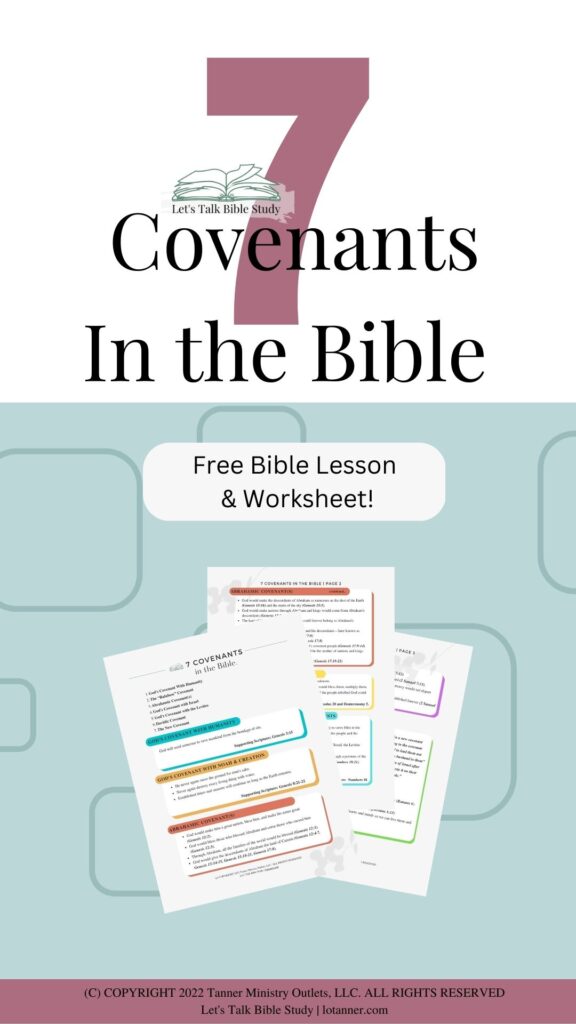
Free Covenants In the Bible pdf!
This __ page printable chart is divided into two sections: an Old Testament Covenants chart and a New Testament Covenants chart.
Click here to download for free! No Strings Attached!
God’s Covenant With Humanity
People often ask What was the first covenant in the Bible? And we’re very quick to assume it’s God’s covenant with Abraham. There are actually two really important covenants that come before that. The first is God’s covenant with Adam & Eve and humanity as a whole.
It comes just moments after God confronts Adam and Eve about their disobedience in the Garden of Eden.
He turns attention to the serpent and says,
“I will put enmity between you and the woman, and between your seed and her Seed. He shall bruise your head, and shall bruise his heel.”
Genesis 3:15
For the serpent, this is bad news. For humanity, this is a promise of salvation. Sin and evil will not go unopposed. And the Lord will raise up a Savior, One who will crush the head of the serpent. The salvation and the entire story line of the Bible is based on God’s faithfulness to this unconditional promise. He doesn’t outline exactly how this victory will. And He doesn’t say when. He simply says it will happen. And through Jesus much of it has! When Jesus returns, the rest of it will.
God’s Covenant With Noah and Creation
Most of us have learned to sum up this covenant as God’s promise to never again destroy the Earth by flood. Did you know there’s actually more to it than that?
In God’s covenant with Noah, God promises:
- He never again curse the ground for man’s sake (Genesis 8:21).
- Never again destroy every living thing with water (Genesis 8:21).
- Established times and seasons will continue as long as the Earth remains (Genesis 8:22)
“While the earth remains, seedtime and harvest, cold and heat, winter and summer, and day and night, shall not cease.
Genesis 8:22
Learn more about the story of God, Noah and the flood here.
God’s Covenant With Abraham
Abraham is one of the first examples we have of an ongoing relationship with God. Through Genesis we get glimpses of God and Abraham’s relationship at different seasons. They talked a lot and much of what was talked about revolved around promises and covenants made between the two of them.
How many covenant did God make to Abraham? What’s interesting about the promises and covenants God made with Abraham is they all kind of flow into each other. Instead of giving you a definite number, I’m going to give you this list of the covenants as I’ve come across in the Bible.
- God would make him a great nation, bless him, and make his name great (Genesis 12:2).
- God would bless those who blessed Abraham and curse those who cursed him (Genesis 12:3).
- Through Abraham, all the families of the world would be blessed (Genesis 12:3).
- God would give the descendants of Abraham the land of Canaan (Genesis 12:4-7, Genesis 13:14-15, Genesis 15:18-21, Genesis 17:8).
- God would make the descendants of Abraham as numerous as the dust of the Earth (Genesis 13:16) and the starts of the sky (Genesis 15:5).
- God would make nations through Abraham and kings would come from Abraham’s descendants (Genesis 17:3-6)
- The land of Canaan (the promised land) would forever belong to Abraham’s descendants (Genesis 17:8)
- The covenant between God and Abraham (and his descendants – later known as Israel) is an everlasting covenant (Genesis 17:8)
- God would always be the God of Israel (Genesis 17:8)
- Circumcision would be a physical sign of God’s covenant people (Genesis 17:9-14)
- Abraham’s wife would conceive and she would be the mother of nations and kings (Genesis 17:15-16)
- God would establish his covenant with the Isaac (Genesis 17:19-23)
The Mosaic Covenant | God’s Covenant With Israel
The Mosaic covenant is built on the 10 Commandments. It is a covenant between God, Israel, and those who are grafted into Israel by faith or conversion. The conditions of this covenant can be found in Exodus 20 and also in Deuteronomy 5.
If the people obeyed these terms, God would bless them, multiply them, prolong their days, and keep them established in Israel. If the people rebelled God could choose to remove the blessing.
When we look at the history of Israel in the Old Testament we see both ends of this covenant being played out at different times. There were times when Israel enjoyed the blessings of obedience and times with rebellion brought heavy grievance. Even in the seasons of heavy grief, the door to repentance was always open and God always preserved a remnant that He could raise up to bring restoration to the nation.
This is probably the covenant people have the most questions about. This post provides a quick summary of the covenant. We’ll dig into the details of it in full in a future post.
God’s Covenant With the Levites (Priests)
God’s covenant with the Levites is unique to the covenant with the rest of Israel. From the 12 tribes of Israel God chose the Levites to serve Him in the temple, and to facilitate offerings and sacrifices to atone for the people and the nation.
Instead of receiving land allotments like the other 11 tribes of Israel, the Levites received a portion of the offerings made to the Lord.
“Behold, I myself have taken your brethren the Levites from among the children of Israel; they are a gift to you, given by the Lord to do the work for the tabernacle of meeting. Therefore you and your sons with you shall attend to your priesthood for everything at the altar and behind the veil; and you shall serve…”
Numbers 18:6-7
This covenant is also called “the covenant of salt” (Numbers 18:19).
As a part of this covenant God commits to providing for the priests and their families through a portions of the heave offerings (Numbers 18-20) and the tithes of the people (Numbers 18:21). Levites were not given land allotments like the other 11 tribes and their time was the Lord’s. This provision allowed them to keep doing their jobs without concerns of providing for their families.
“But the Levites have no part among you, for the priesthood of the Lord is their inheritance…” Joshua 18:7
For thus says the Lord: ‘David shall never lack a man to sit on the throne of the house of Israel; nor shall the priests, the Levites, lack a man to offer burnt offerings before Me, to kindle grain offerings, and to sacrifice continually.”
Jeremiah 33:18
The Davidic Covenant
The Davidic covenant is a promise from God to David. It was delivered by the prophet Nathan and outlines the following events:
- David would have a son who would be king (2 Samuel 7:12)
- David’s son (Solomon) would build the temple of the Lord (2 Samuel 7:13).
- David’s son’s kingdom would be established forever and mercy would not depart from him (2 Samuel 7:13-14).
- The house and kingdom and throne of Judah would be established forever (2 Samuel 7:16)
It’s our belief that the king who sits on the throne of Judah forever is Jesus.
What Is the New Covenant In the Bible?
Most people hear the words “new covenant” and think of Jesus’ words in Luke 22. Interestingly enough, Jesus wasn’t the first to talk about a new covenant. It was prophesied prior by the prophet Jeremiah.
“Behold, the days are coming, says the Lord, when I will make a new covenant with the house of Israel and the house of Judah – not according to the covenant I made with their fathers in the day that I took them by the hand to lead them out of the land of Egypt, My covenant which they broke though I was a husband to them” says the Lord. “But this is the covenant I will make with the house of Israel after those days says the Lord: I will put My law in their minds and write it on their hearts; and I will be their God and they shall be my people.”
Jeremiah 31:31-33
When Jesus initiates the new covenant in Luke 22, this is the work he is committing to completing. Through His death He atones for the sins of the world (as prophesied in Isaiah 53 and Psalm 22) and crushes the head of the serpent (as prophesied in Genesis 3). Through the Holy Spirit He will put the law of God in our hearts and minds – convicting us of sin and righteousness (John 16:8), guiding us in truth, speaking with the authority of God and preparing us for the days to come (John 16:13).
This is what Jesus taught His disciples about the New Covenant.
Many people wonder if the new covenant was for all people or just for the Jewish people. Although the covenant itself was announce (primarily) to the Jews first at the last supper before Passover, Jesus made it clear that anyone who wants to partake in this covenant is welcome. In fact, he taught His disciples to go out and invite other to become a part of it.

How to Enter A Covenant With God
God has already invited you and I to be a part of this new covenant. The first step to entering into a covenant with God is simply responding.
Paul describes keeping covenant with God in 3 simple steps.
- Choose Jesus as your Lord and Savior.
- Confess our sins
- Follow Jesus’s instructions
Choose to Follow Jesus
Jesus teaches us that He is the only path to eternal life. Based on this knowledge Paul teaches,
“That if you confess with your mouth the Lord Jesus and believe in your heart that God has raised Him from the dead, you will be saved.”
Romans 10:9
When we come under Jesus’ covering He becomes our Savior AND our Lord. Meaning, we humble ourselves and follow Him; His teachings, His values, His voice.
Confess Our Sins
What exactly do we need saving from? The wages of sin in our lives.
The new covenant is the solution to problem presented to us in Genesis 3. Sin entered the world and brought with it corruption and death.
“For the wages of sin is death, but the gift of God is eternal life in Christ Jesus our Lord.”
Romans 6:23
When we choose to confess Jesus as the Lord of our lives and confess our sins to Him, He responds with love and forgiveness.
“If we confess our sins, He is faithful and just to forgive us our sins and cleanse us from all unrighteousness.”|
1 John 1:9
It’s that simple.
Following Jesus and Keeping Covenant with God
The next step is to simply listen and follow. Learn what honors God and do it. Learn what grieves Him and stay away from it.
These are things we can learn through studying the Bible, prayer, and fellowship with other believers.
These practices will help transform the way you live and think (Romans 12:2). They’ll help you adopt the priorities of heaven (Matthew 16:33 and Colossians 3:1-2) and live in a way that serves God and others well.
And the cool thing is that even though God expects us to change our ways and follow Him, He knows that we won’t be perfect at it. And when the day comes that we do make a mistake and find ourselves guilty of sin, He’s there with the same grace that welcomed us into a covenant with Him in the first place. This is called repentance. We’ll talk more about this in an upcoming post.
7 Covenants in the Bible! Free chart inside! Share on X